 |
|
|
How to
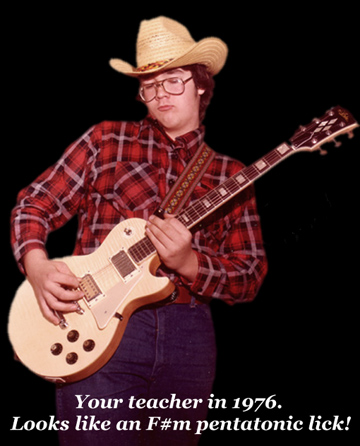
Choose a Guitar Teacher So what type of teacher do you want? First, of course, you want someone who has both experience and patience. Just as important, though, you need to find a teacher who wants to teach what you want to learn while providing the necessary fundamentals in a fun but effective way. And finally, you want someone who is deeply committed to teaching. Many guitar teachers drift into the profession after abandoning their dreams to make it big as a performer. I'm not one of those. I have been a teacher as well as a player for many years. I got my first guitar in 1976 and taught my first lessons in 1982. While I have taken occasional career detours, I always return to music. During one of those breaks, I trained as a foreign language instructor, an experience that has proven surprisingly applicable to my work as a guitar instructor. As you consider prospective teachers, I strongly suggest you be particularly on the lookout for teachers who advise you to do "whatever feels natural." There is such a thing as proper technique, and sometimes it's not the most comfortable, or "natural," way at the start. It is much harder to correct an ingrained bad habit than it is to learn how to do things the right way from the get go. Watch for these red flags: A teaching
rate that's too good to be true. Excellent
teachers are in demand and usually already have a lot of students.
These teachers are usually not cheap. The going rate for good
teachers in this area is between $20-$30 per half-hour private
lesson. Don't settle for the teacher with the lowest rates. You
usually get what you pay for: a beginning teacher or a college
student looking for a little extra cash. This is not what you
want. I can guarantee that. Someone who has just begun teaching. Some folks are great out of the blocks, but someone with at least three years experience is highly likely to be much better. Someone who
claims proficiency in all styles of music. I'm
not saying it's impossible, I'm just saying that most people
who fit this description are earning big bucks in the studios
of LA or Nashville. They are not primarily teachers. As you start
out, find someone who plays in a style you like. Later, as you
start to master diverse genres, seek out different teachers with
expertise in what you want to learn. Yeah, it Group lessons: Private lessons are better. Period. They cost more but you learn a lot more, and a lot more quickly. In the end private lessons will save you money, and they will greatly reduce the likelihood of your quitting out of boredom. Finally, don't assume that someone knows how to teach simply because he or she is a fluent player. A good teacher should have mastery of the instrument but that's only the beginning, not the end. Ask for references from students at your (or your child's) level and also ask whether the teacher has any long-term students to whom you can speak about the teacher. There is no certifying organization out there denoting great or poor teachers. Anyone can call himself a good teacher, but the actual number of teachers who are committed, dedicated and willing to work with you on your terms as well as providing you with the basics and fundamentals is surprisingly limited. |
 Only
a teacher can help you separate the useful information from the
garbage (there's plenty of both out there). More important, only
a skilled teacher can watch you play, quickly identify what you're
doing wrong, and offer you a variety of drills that can correct
your problems. There's a reason Roger Federer, Aaron Rodgers,
and other top professional athletes all work closely with personal
coaches. Even the best at what they do need the help of a good
teacher.
Only
a teacher can help you separate the useful information from the
garbage (there's plenty of both out there). More important, only
a skilled teacher can watch you play, quickly identify what you're
doing wrong, and offer you a variety of drills that can correct
your problems. There's a reason Roger Federer, Aaron Rodgers,
and other top professional athletes all work closely with personal
coaches. Even the best at what they do need the help of a good
teacher. gets a little expensive at that point, but if you
get that far you're a serious player, and cost isn't your top
priority anymore. Getting better is.
gets a little expensive at that point, but if you
get that far you're a serious player, and cost isn't your top
priority anymore. Getting better is.